
A Finite World
Dispair, maxxing, cups that need filling

You’re reading From the Desk by Miles Farnsworth, a monthly newsletter about the arts, spirituality, and the good life.
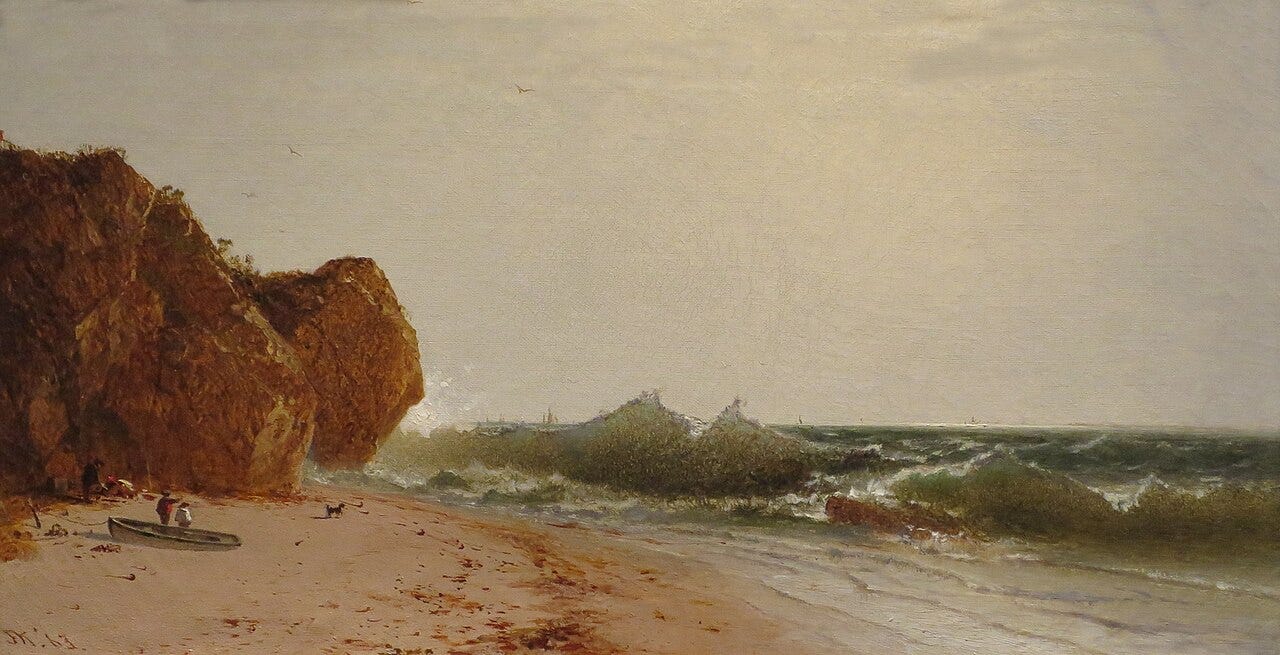
Our family spent four days on the Oregon Coast in early May. It’s a magical place. The mountains run up to the ocean, sometimes crumbling right into its depths. There are tide pools and weathered rock formations and quaint towns with art shops, seafood, and wind-blasted shacks filled with curiosities from local beachcombers.
Yet, at some point, the Oregon Coast ends, bounded arbitrarily by the California border to the south and the Columbia River to the north. It’s not unrealistic to imagine that one could see it all, traverse all 363 miles, stopping in every town, visiting every beach, and pausing below each lighthouse.
Thoughts like these make the world feel small. Everything can be numbered, delineated. Five oceans, seven continents, 195 countries (give or take). Doesn’t it seem strange that you can count it? That there could be a limit to the number of beautiful things in the world?
When you consider the finitude of the physical world, you realize it applies everywhere. There are a finite number of great books and works of art. Types of animals, berries you could digest, things you can buy.
Our biggest limitation, of course, is time. That’s true in the “we’re all going to die one day” sort of existential panic. One can’t wander down that path too often without getting a little freaked out. You start to realize just how little time you have with your children, or how few times you may realistically see your parents (2-3x a year for 30 more years?).
But even when we aren’t pondering the bounds of our mortality, time is finite from day to day, week to week, and month to month.
Is this a useful lens to view world? Most days, the scope of our planet feels almost too expansive; too much in the world to ever understand; too much time in the day to deliberately take advantage of each moment. We’re caught in the middle, trying our best to make the most of it.
How do we cope?
I came across an interesting article a few months ago in which a college professor described his young students' defeatist attitude toward travel. They feel that “the imaginative territory is, for the first time, exhausted,” and that “Google Maps has reached every corner.” Most dismaying, “They arrived at adulthood having already seen, through screens, every place the previous generations would have gone to find.”
I empathize. Technology has indeed flattened the world in a way that can make it less thrilling. You can find the answer to anything with the few clicks of a button. Curiosity starts to feel fleeting rather than consuming.
Rather than dismay at “exhausted imaginative territory”, the opposite approach would be to wrangle the world, to travel as much as we can, to live as Rilke suggested, to “let everything happen to you.” Finitude is not a limitation, but a challenge. And in doing so, we triangulate ourselves within the world, master it, adding notches to our belt along the way.
You can go too far in this direction. There’s a new verb to describe this: “maxxing”. It dangles limply at the end of any noun. Sleepmaxxing: getting lots of sleep. Beachmaxxing: spending all summer on the sand and surf. Looksmaxxing: going to ungodly lengths to make oneself as attractive as possible.
It’s easy to laugh at something like Looksmaxxing, the sick vanity of such a project, but who among us doesn’t sometimes wish to max out some part of our life? We think, “If I could only dedicate my life to (fill in the blank here), I would become who I was meant to be.” I fall into this trap all the time. Summer rolls around, and it starts to feel like any minute not spent on my bike is a minute wasted. Or when I’m writing something and enter that flow state, I get to thinking, wow, if only I could quit my job and make it as a writer.
Instead, reality awaits, full of responsibilities and commitments. The world shrinks around you, a result of where you were born, your tastes, your income. Novelty is hard to come by. None of this is inherently bad.
But I return to my original question. If the solution isn’t to despair at the finitude of the world nor to max out in the relentless pursuit of some single objective, how do we cope?
Cups That Need Filling
The phrase “Cups That Need Filling” kept coming to mind as I wrote this essay. In life, we drink from many different fountains, and it is to those fountains that we must return, as often as required, to fill our cup and be replenished.
For example: for me, reading is a cup that needs filling. How often? Almost daily. Should a few days pass that I haven’t cracked open a book for a few minutes, my life feels out of sorts.
Fitness replenishes me. That cup needs about 30-60 minutes, five days a week.
Art replenishes me. Visiting a museum 4-5 times a year feels about right.
Being in nature and appreciating the beauty of the earth is a cup that needs filling. Ideally, that’s at least two or three times a year somewhere spectacular, like a national park, the ocean, or camping somewhere secluded beneath towering trees.
Relationships need nourishment, but not all relationships require constant attention. I’m always surprised how quickly my cup fills again after seeing an old friend or after a few days gathered in Utah with my brothers and sisters. With all relationships, the quality of the time is often more impactful than the quantity. For the last week, my wife and I have relished playing Yahtzee together each night before bed. A focused 30 minutes playing with my kids means more than a distracted two hours.
I don’t mean we should optimize for the bare minimum, putting in just enough to keep relationships or talents or interests viable. But the truth remains that a little time often goes a long way, and in some cases, it even compounds.
I’ll end back where I started, at the Oregon Coast. Each night, I found myself drawn back to the beach to watch the sunset. It was almost a compulsion. None of the sunsets were particularly stunning, though each was different enough to make the short walk worthwhile. The lighting was never quite the same, nor were the sounds, or the smells, or the temperature. And more importantly, I was not the same, sometimes clear-headed, sometimes contemplative, sometimes fatigued.
The world may be finite, and so might our time, but paired with our ever-changing, ever-growing selves, the combinations are limitless.

Well done, Miles. My reading and contemplation cup overflowed wonderfully today. Thank you! 🙏